15 Best AI Marketing Tools in 2026 for SEO, Content, Ads and Automation
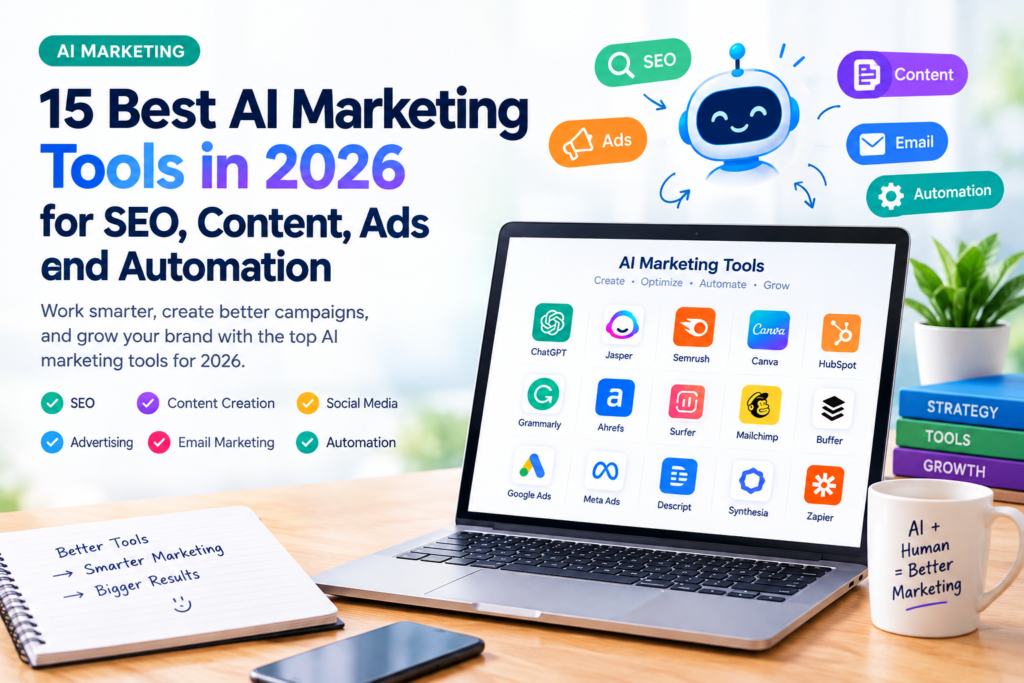
Artificial intelligence is changing how businesses plan marketing campaigns, create content, understand customers, and measure performance. Tasks that once required hours of manual work can now be completed faster with the right AI marketing tools.
From writing blog posts and designing social media graphics to researching keywords and automating email campaigns, AI-powered software can help businesses improve their marketing workflows.
However, choosing the right tool is not always easy. Some platforms specialize in content creation, while others focus on search engine optimization (SEO), advertising, analytics, or customer relationship management.
In this guide, we explore the 15 best AI marketing tools in 2026, explain what each tool does best, and help you choose the right options for your business, budget, and marketing goals.
What Are AI Marketing Tools?
AI marketing tools are software applications that use artificial intelligence to help marketers plan, create, manage, or analyze marketing activities.
Depending on the platform, these tools can help you:
- Generate blog ideas, outlines, emails, and advertising copy.
- Research keywords and identify content opportunities.
- Create images, videos, and social media graphics.
- Personalize customer communications.
- Automate repetitive marketing tasks.
- Analyze campaign performance and customer behavior.
For example, a small business could use an AI writing assistant to draft a blog post, a design tool to create its featured image, an SEO platform to research keywords, and an email marketing tool to distribute the content.
The objective is not to replace every human marketing task. It is to reduce repetitive work, support better decisions, and give marketers more time to focus on strategy, creativity, and customer relationships.
15 Best AI Marketing Tools in 2026
The following tools are grouped by their primary use cases. This is a practical shortlist rather than a universal ranking because the best option depends on your requirements.
1. ChatGPT — Best for Marketing Ideas and Content Creation
ChatGPT is a versatile AI assistant that can support many stages of a marketing campaign.
You can use it to brainstorm blog topics, develop content outlines, draft social media captions, write email variations, summarize research, and generate campaign ideas.
Best uses:
- Blog and article planning.
- Marketing copy and content repurposing.
- Audience research and brainstorming.
- Campaign messaging and creative concepts.
Why choose it?
ChatGPT is useful when you need one flexible assistant for different marketing tasks. For example, you could turn a product description into a blog outline, five social media posts, and an email newsletter draft.
Keep in mind: Review factual claims, edit the output for your brand voice, and verify important information before publishing.
Website: https://chatgpt.com/
2. Jasper — Best for Brand-Focused Marketing Content
Jasper is an AI content platform designed for marketing teams that need to create consistent brand messaging across multiple channels.
It can support the production of advertising copy, campaign content, blog drafts, and other marketing assets.
Best uses:
- Campaign copywriting.
- Brand-consistent content.
- Marketing content production across teams.
- Reusable content workflows.
Jasper may be a good fit for agencies and larger marketing teams that regularly produce multiple types of content.
Keep in mind: Consider whether its specialized features justify the subscription cost compared with a general-purpose AI assistant.
Website: https://www.jasper.ai/
3. Semrush — Best for SEO Research and Optimization
Semrush is a digital marketing platform with tools for keyword research, competitor analysis, website audits, and content optimization.
Its content toolkit also supports workflows such as topic research, content creation, and optimization for traditional and AI-powered search experiences. <Cite refs={[“turn641281search18”]}/>
Best uses:
- Finding relevant keyword opportunities.
- Researching competitors.
- Identifying technical SEO issues.
- Planning and optimizing content.
For example, before writing an article about email marketing, you can research related search terms and use the findings to build a more useful content plan.
Keep in mind: Keyword data is an estimate, not a guarantee of future traffic or rankings.
Website: https://www.semrush.com/
4. Canva — Best for Social Media Graphics and Visual Content
Canva makes it easier to create marketing visuals without requiring advanced graphic design skills. Its AI-assisted features can support the creation and refinement of designs and other visual assets.
Best uses:
- Social media posts.
- Blog featured images.
- Presentations and infographics.
- Advertising creatives.
- Branded marketing templates.
For instance, after writing a blog post, you can create a matching thumbnail, a carousel for social media, and a promotional graphic using a consistent visual style.
Keep in mind: Check image licensing, brand consistency, and the accuracy of any text generated inside graphics.
Website: https://www.canva.com/
5. HubSpot — Best for CRM and Marketing Automation
HubSpot combines customer relationship management (CRM) with marketing, sales, and customer service tools. Its AI features can support content creation and other marketing workflows within the platform. <Cite refs={[“turn641281search2″,”turn641281search15”]}/>
Best uses:
- Managing customer and lead information.
- Creating marketing emails and landing-page content.
- Organizing lead nurturing workflows.
- Connecting campaign activity with customer records.
A business could use a CRM to organize leads, send relevant follow-up emails, and understand how marketing activity contributes to sales.
Keep in mind: Advanced automation and AI capabilities may depend on the product tier, usage limits, or additional credits.
Website: https://www.hubspot.com/
6. Grammarly — Best for Editing and Improving Marketing Copy
Grammarly helps writers improve grammar, clarity, tone, and readability. Its writing assistance can be useful when preparing content for different audiences and channels.
Best uses:
- Proofreading blog posts.
- Editing marketing emails.
- Improving sentence clarity.
- Checking tone and professional communication.
It is particularly useful during the editing stage, when a draft needs to sound natural and polished.
Keep in mind: A grammatically correct article still needs factual review, original insights, and a clear message.
Website: https://www.grammarly.com/
7. Ahrefs — Best for Keyword Research and Content Opportunities
Ahrefs provides SEO tools for keyword research, backlink analysis, competitor research, and website performance investigations.
Best uses:
- Discovering keyword opportunities.
- Analyzing competing pages.
- Reviewing backlink profiles.
- Finding content gaps.
For example, you can study the topics covered by competing websites and identify unanswered questions that your article could address more effectively.
Keep in mind: Competitor research should help you find opportunities to add value, not copy another website’s content.
Website: https://ahrefs.com/
8. Surfer — Best for On-Page Content Optimization
Surfer is designed to help content teams evaluate and optimize web pages using SEO-related recommendations.
It can support content planning and help writers review how well an article covers a topic in relation to the search results being analyzed.
Best uses:
- Improving existing blog posts.
- Preparing SEO content briefs.
- Reviewing topic coverage.
- Supporting on-page optimization.
It can be useful when your team publishes content regularly and needs a repeatable optimization process.
Keep in mind: Do not sacrifice readability to achieve a particular optimization score. The article must answer the reader’s question first.
Website: https://surferseo.com/
9. Mailchimp — Best for Email Marketing
Mailchimp helps businesses create email campaigns, manage subscribers, and organize customer communications. Depending on the available plan and features, its tools can support audience targeting and marketing automation.
Best uses:
- Email newsletters.
- Promotional campaigns.
- Subscriber management.
- Automated customer follow-ups.
For example, an online store could send a newsletter featuring new products and relevant offers to subscribers who have agreed to receive marketing emails.
Keep in mind: Follow applicable privacy requirements and email marketing rules, and avoid sending irrelevant messages too frequently.
Website: https://mailchimp.com/
10. Buffer — Best for Social Media Scheduling
Buffer helps creators and businesses plan and publish social media content across supported channels. AI-assisted writing features can also help generate or refine post ideas.
Best uses:
- Scheduling social media posts.
- Organizing a content calendar.
- Adapting messages for different platforms.
- Managing a consistent publishing routine.
A marketing team can turn one article into several social posts and schedule them across the week.
Keep in mind: Review every post for platform suitability, brand voice, and current information before publishing.
Website: https://buffer.com/
11. Google Ads AI Features — Best for Paid Search Advertising
Google Ads includes AI-powered campaign capabilities designed to help advertisers manage aspects of targeting, creative, and campaign optimization.
Best uses:
- Supporting campaign optimization.
- Testing advertising messages.
- Managing relevant search advertising workflows.
- Evaluating paid campaign performance.
These features can help marketers work with campaign data and advertising automation while maintaining clear business goals.
Keep in mind: Automation does not guarantee profitable campaigns. Set appropriate budgets, monitor conversions, and assess the quality of the customers you acquire.
Website: https://ads.google.com/
12. Meta Advantage+ — Best for Facebook and Instagram Advertising
Meta’s Advantage+ advertising capabilities use automation to support parts of campaign delivery and optimization across eligible Meta advertising placements.
Best uses:
- Running social advertising campaigns.
- Testing creative variations.
- Supporting audience and delivery optimization.
- Promoting products and services.
For an ecommerce business, paid social campaigns can help present products to potential customers and evaluate which creative approaches produce useful results.
Keep in mind: Performance depends on factors such as creative quality, offer, audience, tracking, and campaign setup. Monitor results rather than assuming automation will fix a weak campaign.
Website: https://www.facebook.com/business/ads
13. Descript — Best for Video and Podcast Content
Descript supports audio and video editing through a workflow that includes transcript-based editing and other production tools.
Best uses:
- Editing podcasts.
- Producing video content.
- Creating short clips from longer recordings.
- Preparing marketing videos and tutorials.
For example, a company can turn a recorded webinar into shorter educational clips for social media and its website.
Keep in mind: Review transcripts, captions, and edited footage for errors before publication.
Website: https://www.descript.com/
14. Synthesia — Best for AI-Assisted Marketing Videos
Synthesia helps users create videos using AI-generated presenters and related production features.
Best uses:
- Product explainers.
- Training and onboarding videos.
- Educational marketing content.
- Presentations and internal communications.
It can be helpful when a business needs repeatable video content without filming every update in a traditional studio.
Keep in mind: Use authorized assets and voices, disclose synthetic media when appropriate, and ensure the final video meets your brand’s quality standards.
Website: https://www.synthesia.io/
15. Zapier — Best for Connecting Marketing Workflows
Zapier connects supported applications through automated workflows. It can help move information between tools and trigger actions when specific events occur.
Best uses:
- Sending lead information between applications.
- Automating repetitive administrative tasks.
- Connecting forms with CRM systems.
- Triggering notifications and follow-up workflows.
For example, when a potential customer submits a website form, an automation could send the information to a CRM and notify the relevant team.
Keep in mind: Test workflows carefully, protect customer information, and include safeguards against duplicate records or unintended actions.
Website: https://zapier.com/
Comparison Table: Which AI Marketing Tool Should You Choose?
| Tool | Best for | Ideal users |
|---|---|---|
| ChatGPT | Ideas and content drafting | Most marketers |
| Jasper | Brand-focused copy | Agencies and content teams |
| Semrush | SEO research | SEO professionals |
| Canva | Visual content | Creators and small businesses |
| HubSpot | CRM and automation | Growing businesses |
| Grammarly | Editing and clarity | Writers and marketers |
| Ahrefs | Keywords and competitor research | SEO specialists |
| Surfer | On-page optimization | Content teams |
| Mailchimp | Email campaigns | Small businesses and ecommerce |
| Buffer | Social scheduling | Creators and social teams |
| Google Ads AI features | Paid search campaigns | Advertisers |
| Meta Advantage+ | Paid social campaigns | Social advertisers |
| Descript | Audio and video editing | Video creators |
| Synthesia | AI-assisted video production | Marketing and training teams |
| Zapier | Workflow automation | Operations and marketing teams |
How to Choose the Right AI Marketing Tool for Your Business
Buying multiple subscriptions does not automatically create a better marketing strategy. Start by identifying your biggest bottleneck.
Step 1: Define Your Marketing Goal
Are you trying to increase organic traffic, publish content more efficiently, generate leads, improve advertising performance, or maintain a consistent social media presence?
Choose a tool that directly supports that goal.
Step 2: Check Your Existing Software
Before paying for another platform, review the features included in your current subscriptions. Your existing email platform, CRM, design tool, or advertising account may already provide useful AI capabilities.
Step 3: Compare Total Costs
Look beyond the advertised starting price. Check user limits, usage credits, feature restrictions, integrations, and the cost of upgrading as your business grows.
Step 4: Test the Workflow
Run a small, practical test before committing. For example, use a tool to prepare a campaign draft, create a graphic, or automate a routine task. Compare the time saved with the review and correction required.
Step 5: Measure Business Results
Track meaningful outcomes such as qualified leads, conversions, content production time, email engagement, and campaign profitability. A tool is valuable when it contributes to better work or better results—not simply because it uses AI.
Best AI Marketing Tools for Small Businesses
Small businesses often need to manage multiple marketing activities without hiring a large team. A simple collection of tools may be enough to begin.
Consider this practical starting setup:
- Content: ChatGPT for brainstorming and drafting.
- Design: Canva for social graphics and blog images.
- SEO: Semrush or Ahrefs for keyword research and website analysis.
- Email: Mailchimp for newsletters and customer communication.
- Automation: Zapier for connecting repetitive workflows.
You do not need to purchase all five at once. Start with the tool that addresses your most important challenge, then expand when a clear need emerges.
Benefits of Using AI Marketing Tools
When used thoughtfully, AI marketing software can offer several advantages.
Faster content production: AI can help with brainstorming, outlining, drafting, and repurposing content.
More consistent workflows: Templates and automation can reduce repetitive manual work.
Better-informed decisions: SEO and analytics tools can help marketers identify patterns and opportunities.
Easier creative production: Design and video tools can make certain content formats more accessible.
More organized customer communication: CRM and email automation platforms can help teams manage follow-ups and campaigns.
These benefits are not automatic. Results depend on the quality of your strategy, the data available, the tool’s capabilities, and how carefully people review its output.
Common Mistakes to Avoid When Using AI for Marketing
AI can support a marketing team, but careless use can create unnecessary risks.
- Publishing unedited content: Always review facts, tone, originality, and usefulness.
- Choosing tools based only on popularity: Match the tool to your actual workflow.
- Automating without testing: Check that automated messages and integrations behave as intended.
- Ignoring privacy: Do not upload confidential customer or business information without appropriate authorization and safeguards.
- Focusing on output instead of outcomes: More blog posts or advertisements do not necessarily mean more qualified customers.
- Expecting guaranteed SEO results: AI tools cannot guarantee rankings, traffic, or sales.
Use AI as an assistant to support human judgment, not as a substitute for marketing strategy and accountability.
Frequently Asked Questions
1. What are the best AI marketing tools in 2026?
The best tool depends on your goal. ChatGPT can help with content and ideas, Semrush and Ahrefs support SEO research, Canva helps with visual content, HubSpot supports CRM and marketing workflows, and Zapier connects applications through automation.
2. Which AI marketing tool is best for beginners?
ChatGPT and Canva are reasonable starting points for beginners who want to explore content creation and visual design. Choose one based on the task you need to complete and learn its workflow before adding more tools.
3. Can AI marketing tools improve SEO?
They can support keyword research, content planning, editing, and optimization. However, SEO performance also depends on content quality, technical accessibility, competition, search intent, and other factors. No tool can guarantee higher rankings.
4. Are AI marketing tools free?
Some tools offer free plans or limited free features, while others require paid subscriptions. Access to specific AI capabilities may depend on your plan, usage limits, or region. Review the current official pricing pages before purchasing.
5. Can AI tools replace digital marketers?
AI can automate or assist with certain tasks, but marketers still need to understand customers, develop strategy, review claims, manage creative decisions, and evaluate results. Human oversight remains important.
6. How many AI marketing tools should a business use?
There is no ideal number for every business. Start with a small set that covers your main needs, and add another tool only when it solves a clear problem that your current setup cannot address efficiently.
Conclusion
The best AI marketing tools in 2026 are not necessarily the ones with the most features. They are the ones that help your business solve real problems, work more efficiently, and deliver a better experience to customers.
Start with your primary goal. Choose the appropriate tool for content creation, SEO, design, advertising, email marketing, or automation. Test it with a real task, review the results, and measure whether it improves your workflow.
Most importantly, combine AI efficiency with human creativity, reliable information, and a clear understanding of your audience.
Your next step: Choose one repetitive marketing task you want to improve this week. Test one suitable tool, measure the time and effort involved, and decide whether it deserves a permanent place in your marketing workflow.