What Is Agentic AI in Marketing? 7 Real-World Use Cases for Businesses
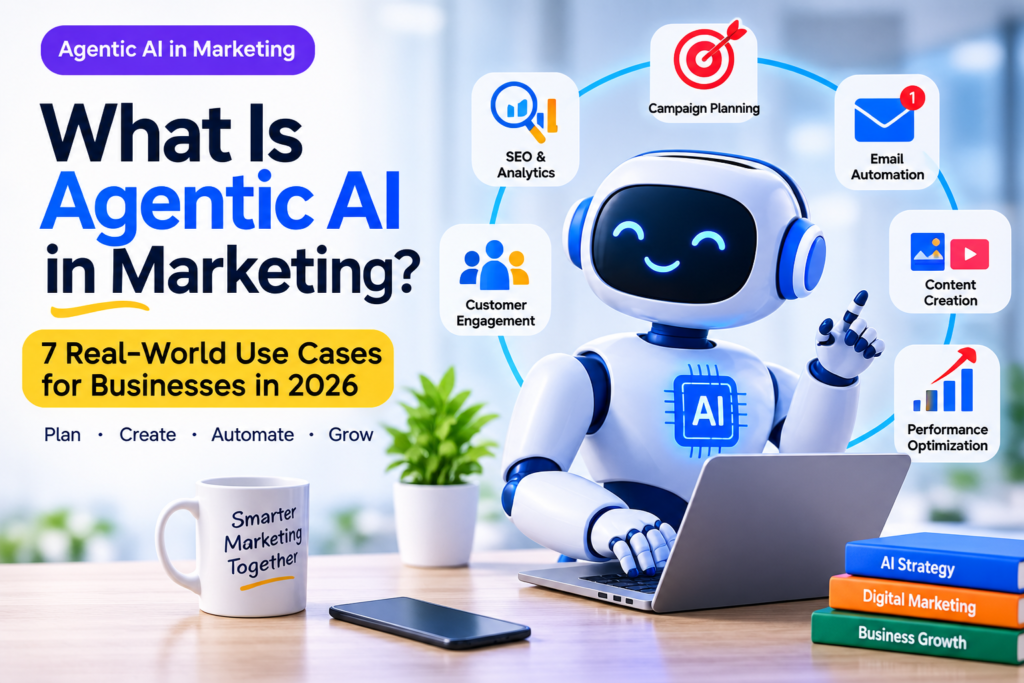
Artificial intelligence is changing the way businesses attract customers, create content, and manage marketing campaigns. But the next stage of this transformation goes beyond generating text or answering questions. It involves AI systems that can plan tasks, use connected tools, and take actions toward a defined goal.
This is where agentic AI in marketing comes in.
Imagine telling an AI system to help launch a new product campaign. Instead of only suggesting ideas, an AI agent could help research the audience, prepare a campaign brief, draft email content, organize tasks, and analyze results through connected marketing tools. Depending on its permissions and capabilities, it may also execute approved steps with limited human intervention.
This approach could help businesses reduce repetitive work, respond to customers more effectively, and coordinate marketing activities across multiple channels.
In this guide, you will learn what agentic AI is, how it differs from traditional AI tools, and seven practical ways businesses can use it in marketing.
What Is Agentic AI in Marketing?
Agentic AI in marketing refers to AI systems designed to pursue specific marketing goals by planning and carrying out multiple related tasks, often using connected software tools and business data.
Unlike a basic chatbot that mainly responds to prompts, an AI agent may be able to evaluate a situation, choose a next step, perform an authorized action, and use the result to continue its workflow.
For example, a traditional AI writing assistant might draft an email promoting a new product. An agentic marketing system could potentially help select an audience, prepare different email versions, send them through an approved marketing platform, and monitor campaign results.
The exact level of independence depends on the system, its integrations, and the permissions granted to it. Human review may still be necessary for important decisions and external actions.
In simple terms, generative AI helps create content, while agentic AI can use AI capabilities and connected tools to help complete a broader task.
How Is Agentic AI Different From Generative AI?
Although the two technologies are related, they serve different purposes.
| Feature | Generative AI | Agentic AI |
|---|---|---|
| Main purpose | Creates content or responses | Works toward a defined goal |
| Typical activity | Writes an email draft | Helps coordinate a multi-step email campaign |
| Use of tools | May be limited to the requested output | Can use connected tools when configured |
| Decision-making | Responds to instructions | Can select next steps within defined boundaries |
| Human involvement | Often requires a person to carry out the next action | May perform authorized actions with less step-by-step guidance |
Agentic AI can use generative AI as one of its capabilities. However, not every AI assistant is an agent, and not every agent can independently complete an entire marketing campaign.
The important difference is the ability to coordinate actions toward a goal, rather than simply producing a single output.
Why Is Agentic AI Important for Businesses in 2026?
Marketing teams often manage many responsibilities at once: content creation, advertising, customer communication, lead generation, analytics, and reporting.
These activities can become difficult to coordinate, especially when teams use several disconnected software platforms.
Agentic AI offers a potential way to organize some of this work.
1. It can reduce repetitive tasks
AI agents may help collect information, prepare reports, organize campaign assets, and perform routine workflow steps. This can give marketers more time to focus on planning and creative decisions.
2. It can support personalized marketing
With appropriate data access and privacy controls, AI agents can help tailor messages to customer preferences, previous interactions, or stages of the buying journey.
3. It can connect different marketing activities
Agents with suitable integrations can help move information between systems, coordinate follow-up tasks, and reduce manual handoffs.
4. It can support faster responses
A properly configured agent may respond to common customer questions or route complex requests to the right team.
These benefits are possibilities, not guaranteed outcomes. Results depend on data quality, system capabilities, workflow design, and human oversight.
7 Real-World Use Cases of Agentic AI in Marketing
Here are seven practical applications businesses can explore.
1. AI-Powered Campaign Planning and Execution
Planning a marketing campaign involves several steps: defining the target audience, developing a message, choosing channels, creating assets, and coordinating launch activities.
An agentic AI system can help organize these steps around a specific objective.
For example, a business launching a new online course could assign an agent to help prepare a campaign plan. The agent might review the campaign brief, suggest audience segments, draft email and social media content, and prepare a checklist for launch.
If connected to the relevant marketing platforms, it may also be able to perform approved actions, such as creating draft campaigns or scheduling content.
Business benefit: Better coordination and less manual work across campaign planning.
Human oversight: A marketer should approve the campaign message, budget, audience, and final launch before anything goes live.
2. Personalized Email Marketing
Generic emails often fail to address the different needs of customers. Agentic AI can help businesses organize more relevant communication using approved customer data and predefined marketing rules.
For example, an online store could use an AI agent to identify customers who have shown interest in a product category. The system could help prepare relevant email content and organize a follow-up sequence based on customer interactions.
A more advanced setup might coordinate actions across a customer relationship management (CRM) platform and an email marketing tool.
Business benefit: More relevant communication and potentially more efficient campaign management.
Human oversight: Ensure that customer data is handled appropriately, consent requirements are respected, and automated messages do not make misleading claims.
3. AI-Assisted Content Marketing
Content marketing requires research, planning, writing, editing, publishing, and distribution. An agentic workflow can help coordinate these activities.
Suppose a software company wants to publish a series of educational articles about cybersecurity. An AI agent could help identify questions customers ask, organize topic ideas, prepare outlines, draft content, and suggest related social media posts.
It might also help maintain a content calendar or flag articles that need updating.
However, automatically generated content should not be published without appropriate checks. Technical claims, statistics, quotations, and product details need verification.
Business benefit: A more organized content workflow and potentially faster production.
Human oversight: Editors should ensure that content is accurate, original, useful, and consistent with the brand’s expertise.
4. Lead Qualification and Follow-Up
Businesses often receive leads from website forms, advertisements, webinars, and other channels. Sales teams then need to identify which prospects are ready for a conversation.
An AI agent connected to an approved CRM could help organize incoming leads, summarize their stated needs, identify missing information, and recommend a follow-up action.
For example, if someone requests a demonstration of a business software product, the system might summarize the request, record relevant details, and prepare a personalized follow-up message for a sales representative.
Depending on the setup, it could route the lead to the appropriate team or send an approved response.
Business benefit: More organized lead management and fewer missed follow-up tasks.
Human oversight: Use clear qualification criteria, protect personal information, and allow people to review important decisions. Avoid treating AI-generated lead scores as perfectly accurate.
5. Customer Support and Conversational Marketing
Customer questions can arrive through websites, email, messaging platforms, and social media. Agentic AI may help handle routine requests and direct more complicated issues to human staff.
For example, a customer visiting an online store might ask about delivery options or return procedures. An AI agent could retrieve information from an approved knowledge base and provide a response.
If the customer has a more complicated complaint, the system could summarize the conversation and transfer it to a support representative.
Business benefit: Faster handling of routine inquiries and more organized support workflows.
Human oversight: Agents should rely on current, approved information and clearly escalate sensitive, ambiguous, or high-impact situations rather than guessing.
6. Advertising Campaign Monitoring and Optimization
Digital advertising requires marketers to monitor spending, evaluate results, test creative assets, and adjust campaigns.
An agentic AI system connected to advertising analytics may help identify unusual performance changes, summarize campaign results, and recommend possible adjustments.
For instance, an agent could flag that an advertising campaign is spending money but generating fewer qualified leads than expected. It might suggest reviewing the landing page, audience settings, or advertisement message.
Some systems may be able to make approved changes within connected platforms, but capabilities vary.
Business benefit: More systematic monitoring and potentially quicker responses to performance changes.
Human oversight: Set strict budget limits and approval rules. Do not allow an AI agent to make unlimited spending decisions or assume that a short-term performance change proves a campaign is failing.
7. Marketing Analytics and Reporting
Marketing teams collect information from websites, email campaigns, advertising platforms, and CRM systems. Turning this information into useful decisions can take considerable time.
An AI agent with suitable data access can help gather information, prepare summaries, identify patterns, and highlight areas that need further investigation.
For example, an agent might prepare a weekly report showing which campaigns generated the most leads, which landing pages had weaker conversion rates, and which trends deserve attention.
It could also recommend questions for the marketing team to investigate.
Business benefit: More efficient reporting and easier access to campaign insights.
Human oversight: Verify the underlying numbers, check how metrics are defined, and distinguish correlation from causation. A report should explain what the data shows without presenting guesses as proven facts.
How to Implement Agentic AI in Your Marketing Strategy
Businesses do not need to automate their entire marketing operation at once. A focused approach is usually easier to evaluate and manage.
Step 1: Choose One Clear Business Goal
Start with a specific problem. You might want to reduce the time spent preparing weekly reports, organize incoming leads, or improve the consistency of email follow-ups.
Avoid vague objectives such as “use AI to improve everything.” A clear goal makes it easier to decide whether the system is useful.
Step 2: Review Your Data and Tools
Identify where the required information is stored and which applications the agent would need to access.
Check whether the data is accurate, up to date, and appropriate for the intended use. Confirm that the necessary integrations are available before designing the workflow.
Step 3: Define Permissions and Guardrails
Decide what the agent may do independently and what requires approval.
For example, it might be allowed to summarize campaign results and prepare email drafts but require a human to approve the final message and recipient list.
Use the principle of least privilege: give the agent only the access necessary to complete its assigned tasks.
Step 4: Test With a Small Pilot
Run the workflow on a limited scale before using it across the business.
Compare the agent’s output with the existing process. Check for incorrect information, failed actions, duplicate records, unexpected costs, and other problems.
Step 5: Measure Results and Improve
Evaluate the pilot using clear indicators, such as time saved, error rates, response times, qualified leads, or campaign performance.
Expand the workflow only when the results justify the additional complexity and risk.
Challenges and Risks of Agentic AI in Marketing
Agentic AI can create useful opportunities, but greater autonomy also requires stronger controls.
Incorrect information: An agent may misunderstand a request or use inaccurate data. Important outputs need verification.
Privacy and security: Connected systems may contain customer information. Access controls, data minimization, and appropriate safeguards are essential.
Unexpected actions: A poorly configured agent could send an incorrect message, update the wrong record, or make an unintended change. Limit permissions and log important actions.
Brand reputation: Automated communication can sound inappropriate or make promises the business cannot keep. Maintain clear brand guidelines and escalation procedures.
Unclear return on investment: Building and maintaining agentic workflows can involve software costs, integration work, monitoring, and staff training. Measure the total cost rather than focusing only on time saved.
Over-automation: Not every task needs an AI agent. Simple, predictable processes may be better handled by traditional automation, while sensitive decisions may require human judgment.
The goal is not maximum autonomy. It is useful automation with appropriate accountability.
Frequently Asked Questions About Agentic AI in Marketing
1. What is an AI agent in digital marketing?
An AI agent is a software system designed to work toward a goal by processing information, selecting actions, and using connected tools when available. In digital marketing, it may help coordinate content workflows, customer communication, lead management, or campaign analysis.
2. Is agentic AI better than generative AI?
Neither is universally better. Generative AI is useful for creating content and ideas. Agentic AI is useful when a task involves multiple steps, decisions, and actions. Some marketing workflows can benefit from combining both.
3. Can agentic AI run marketing campaigns automatically?
Some systems can perform selected campaign tasks when they have the necessary integrations and permissions. However, capabilities vary, and businesses should maintain approval requirements for budgets, public-facing content, customer data, and other consequential actions.
4. Is agentic AI suitable for small businesses?
Yes, potentially. Small businesses can begin with a narrow workflow, such as organizing leads, preparing reports, or drafting follow-up messages. The best starting point is a task that consumes time and can be evaluated clearly.
5. Will agentic AI replace marketing professionals?
Agentic AI may automate some tasks and change how marketing teams work, but businesses still need people to set strategy, understand customers, develop creative ideas, verify claims, manage risk, and evaluate outcomes.
6. How can a business measure the success of agentic AI?
Measure results against the original business goal. Useful indicators may include time saved, task completion rates, error rates, customer response times, lead quality, and campaign outcomes. Include implementation and oversight costs when evaluating return on investment.
Conclusion: Start Small and Build With Confidence
Agentic AI is expanding the possibilities for marketing automation by helping systems move beyond content generation toward coordinated, goal-oriented action.
From campaign planning and personalized email marketing to lead qualification, customer support, advertising analysis, and reporting, there are several ways businesses can explore this technology.
However, successful implementation requires more than choosing an AI platform. Businesses need clear goals, reliable data, suitable integrations, well-defined permissions, and ongoing human oversight.
The smartest way to begin is to choose one repetitive marketing task, test an agent on a small scale, and measure the results. If it improves the workflow without introducing unacceptable risks, you can gradually explore more advanced applications.
Agentic AI should support better marketing decisions, not replace responsibility for them.